
Please Note: This article is written for users of the following Microsoft Word versions: 2007, 2010, 2013, 2016, 2019, and 2021. If you are using an earlier version (Word 2003 or earlier), this tip may not work for you. For a version of this tip written specifically for earlier versions of Word, click here: Noting Formatting Inconsistencies.
Word has had the capability for some time to do "on the fly" checks of both spelling and grammar in your document. Potential spelling errors are marked with a wavy red underline. Depending on your version of Word, potential grammar errors are marked with a wavy green underline, a wavy blue underline, or double blue underlines. Again, depending on your version of Word, formatting inconsistencies are marked with wavy blue underlines or dotted gold line. This last option—to check formatting inconsistencies—is not turned on by default. If you want Word to notify you of these potential mistakes, follow these steps:
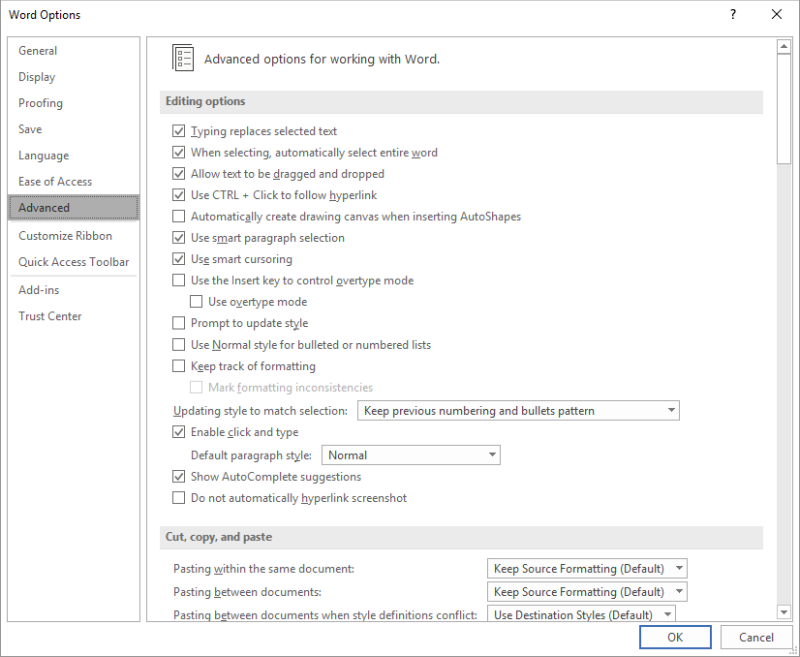
Figure 1. The Advanced options of the Word Options dialog box.
Word now "tracks" the formatting in your document (all behind the scenes) and marks questionable formatting with a wavy blue underline. If you right-click on the underlined text, you can see exactly what Word feels may be wrong with the selection.
WordTips is your source for cost-effective Microsoft Word training. (Microsoft Word is the most popular word processing software in the world.) This tip (12686) applies to Microsoft Word 2007, 2010, 2013, 2016, 2019, and 2021. You can find a version of this tip for the older menu interface of Word here: Noting Formatting Inconsistencies.
Discover the Power of Microsoft Office This beginner-friendly guide reveals the expert tips and strategies you need to skyrocket your productivity and use Office 365 like a pro. Mastering software like Word, Excel, and PowerPoint is essential to be more efficient and advance your career. Simple lessons guide you through every step, providing the knowledge you need to get started. Check out Microsoft Office 365 For Beginners today!
Word allows you to change the character of how your pages are designed by using multiple sections in a document. If you ...
Discover MoreNeed to format the page numbers you added to your document? Word makes it easy, using the same techniques you use to ...
Discover MoreNeed to draw attention to some text? Consider using the Highlight tool, which functions just like the highlighter pens ...
Discover MoreFREE SERVICE: Get tips like this every week in WordTips, a free productivity newsletter. Enter your address and click "Subscribe."
There are currently no comments for this tip. (Be the first to leave your comment—just use the simple form above!)
Got a version of Word that uses the ribbon interface (Word 2007 or later)? This site is for you! If you use an earlier version of Word, visit our WordTips site focusing on the menu interface.
Visit the WordTips channel on YouTube

FREE SERVICE: Get tips like this every week in WordTips, a free productivity newsletter. Enter your address and click "Subscribe."
Copyright © 2026 Sharon Parq Associates, Inc.
 Please Note:
This article is written for users of the following Microsoft Word versions: 2007, 2010, 2013, 2016, 2019, and 2021. If you are using an earlier version (Word 2003 or earlier), this tip may not work for you. For a version of this tip written specifically for earlier versions of Word, click here:
Please Note:
This article is written for users of the following Microsoft Word versions: 2007, 2010, 2013, 2016, 2019, and 2021. If you are using an earlier version (Word 2003 or earlier), this tip may not work for you. For a version of this tip written specifically for earlier versions of Word, click here: 
Comments