
Please Note: This article is written for users of the following Microsoft Word versions: 2007, 2010, 2013, 2016, 2019, and 2021. If you are using an earlier version (Word 2003 or earlier), this tip may not work for you. For a version of this tip written specifically for earlier versions of Word, click here: Inserting a Special Symbol.
In typography there are many special symbols defined in fonts. An example of special symbols would be the bullets used at the front of bulleted lists. Word allows you to quickly and easily insert a special symbol into your document. To do so, follow these instructions:
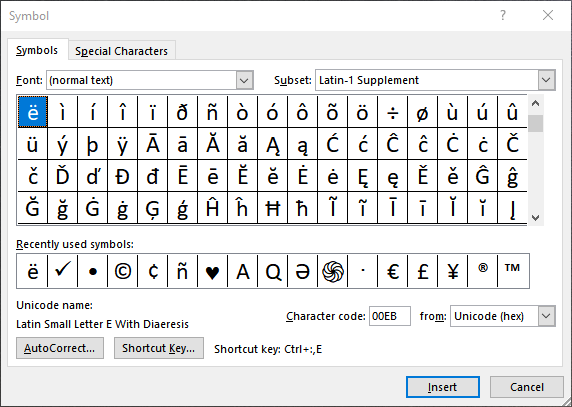
Figure 1. The Symbol dialog box.
WordTips is your source for cost-effective Microsoft Word training. (Microsoft Word is the most popular word processing software in the world.) This tip (10025) applies to Microsoft Word 2007, 2010, 2013, 2016, 2019, and 2021. You can find a version of this tip for the older menu interface of Word here: Inserting a Special Symbol.
The First and Last Word on Word! Bestselling For Dummies author Dan Gookin puts his usual fun and friendly candor back to work to show you how to navigate Word 2019. Spend more time working and less time trying to figure it all out! Check out Word 2019 For Dummies today!
Word allows you to search for special characters that normally do not print such as paragraph marks and line breaks.
Discover MoreEven characters that print nothing still take space in your document. Characters such as tabs, spaces, breaks, and the ...
Discover MoreFREE SERVICE: Get tips like this every week in WordTips, a free productivity newsletter. Enter your address and click "Subscribe."
2026-01-08 09:17:51
To expand a bit on Kiwerry's comment, Windows users can use WinKey+semicolon or WinKey+period.
WinKey (Windows key) is the key with the four-paned Windows logo, usually found bottom left on the keyboard, between Ctrl and Alt. Press and hold Winkey and then tap the period key or the semicolon key, and you'll see a dialog of emoji, GIFs, kaomoji, and symbols.
2026-01-08 05:29:03
Kiwerry
Windows users can apply the "(Win Key) ." hot key to access symbols in a rather different way: (see Figure 1 below)
It is less typographically oriented than the method described by Allen, has the advantage that it can be used all over Windows, not just in Word, it includes coloured emoticons, and it also has a "recently used" collection. It has a bit of a learning curve, but some may nevertheless find it useful, as have I.
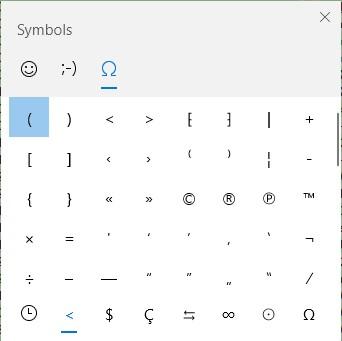
Figure 1.
Got a version of Word that uses the ribbon interface (Word 2007 or later)? This site is for you! If you use an earlier version of Word, visit our WordTips site focusing on the menu interface.
Visit the WordTips channel on YouTube

FREE SERVICE: Get tips like this every week in WordTips, a free productivity newsletter. Enter your address and click "Subscribe."
Copyright © 2026 Sharon Parq Associates, Inc.
 Please Note:
This article is written for users of the following Microsoft Word versions: 2007, 2010, 2013, 2016, 2019, and 2021. If you are using an earlier version (Word 2003 or earlier), this tip may not work for you. For a version of this tip written specifically for earlier versions of Word, click here:
Please Note:
This article is written for users of the following Microsoft Word versions: 2007, 2010, 2013, 2016, 2019, and 2021. If you are using an earlier version (Word 2003 or earlier), this tip may not work for you. For a version of this tip written specifically for earlier versions of Word, click here: 
Comments