
As a freelance academic editor, Norman works with documents from many (usually unknown) earlier versions of Word. In some it is not possible to drag and drop text; he has to, instead, use Ctrl+X and Ctrl+V to move it. Norman would be interested to know what underlying property in the document causes this inconsistent behavior.
The first thing to do is to check to see if drag-and-drop capability is turned on in the document. You can do that by following these steps:
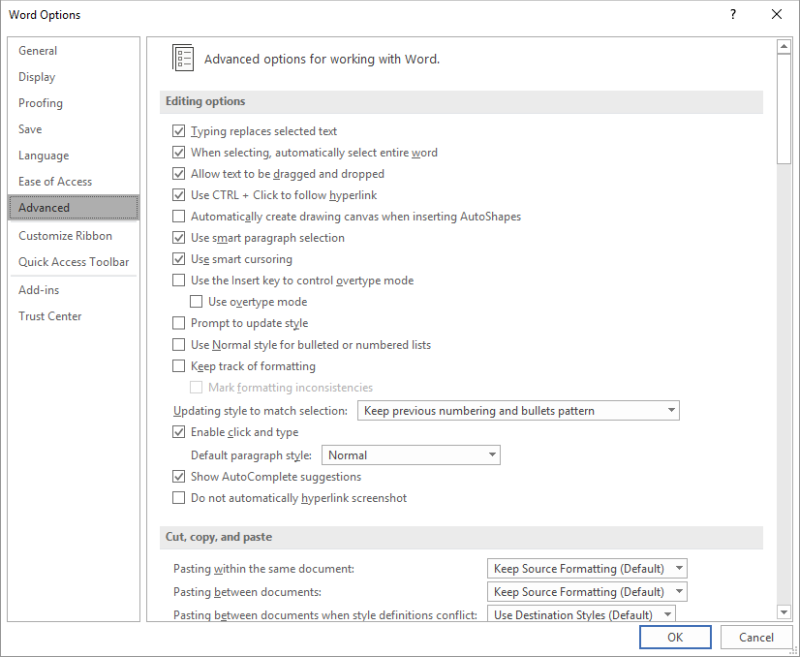
Figure 1. The Advanced options of the Word Options dialog box.
The drag-and-drop setting is handled as a system-wide setting, which means that if it is enabled as detailed above, it should work with all documents you might load.
If drag-and-drop editing is turned on and the problem persists, it could actually be by design. You see, the ability to drag and drop text is dependent on the state in which Word is working at the time. Specifically, it won't work if there are dialog boxes open on the screen. For instance, if you have the Find and Replace dialog box open or the Cross-Reference dialog box open, then you cannot drag and drop. The solution is to close any open dialog box, and you should be good to go.
Another thing to check is if your document is protected in some way. For instance, on the Review tab of the ribbon, there is a Restrict Editing tool. If editing is disallowed, then drag-and-drop won't work because it results in an edit to the paper. In this case, you will need to make sure that editing restrictions are removed, then you can once again use drag-and-drop. Of course, Norman said he can use Ctrl+X and Ctrl+V, which means this possibility isn't likely a culprit.
Finally, in some versions of Word, you also cannot use drag-and-drop editing while the macro recorder is running. If you encounter this issue, then the only solution is to turn off the macro recorder.
WordTips is your source for cost-effective Microsoft Word training. (Microsoft Word is the most popular word processing software in the world.) This tip (13618) applies to Microsoft Word 2007, 2010, 2013, 2016, 2019, 2021, 2024, and Word in Microsoft 365.
The First and Last Word on Word! Bestselling For Dummies author Dan Gookin puts his usual fun and friendly candor back to work to show you how to navigate Word 2019. Spend more time working and less time trying to figure it all out! Check out Word 2019 For Dummies today!
Word allows you to add several types of "breaks" into your document. If you later want to remove any of them, you can use ...
Discover MoreWord has a power capability to search for information and then replace that information in some way. Finding the right ...
Discover MoreSometimes, the characters that appear in a document can be hard to figure out, especially if the document came from ...
Discover MoreFREE SERVICE: Get tips like this every week in WordTips, a free productivity newsletter. Enter your address and click "Subscribe."
There are currently no comments for this tip. (Be the first to leave your comment—just use the simple form above!)
Got a version of Word that uses the ribbon interface (Word 2007 or later)? This site is for you! If you use an earlier version of Word, visit our WordTips site focusing on the menu interface.
Visit the WordTips channel on YouTube

FREE SERVICE: Get tips like this every week in WordTips, a free productivity newsletter. Enter your address and click "Subscribe."
Copyright © 2026 Sharon Parq Associates, Inc.

Comments