
Please Note: This article is written for users of the following Microsoft Word versions: 2007, 2010, 2013, 2016, 2019, 2021, 2024, and Word in Microsoft 365. If you are using an earlier version (Word 2003 or earlier), this tip may not work for you. For a version of this tip written specifically for earlier versions of Word, click here: Footnotes within Footnotes.
Footnotes are a common feature in many types of documents. In some types of documents, you may actually need footnotes within footnotes, such that a footnote can be footnoted, with the "sub footnote" appearing in the regular flow of the main footnotes. (For those with a linguistic or literary bent, you can find out about footnotes within footnotes by referring to a style guide, such as Kate Turabian's book, Manual for Writers, or the Chicago Manual of Style.)
Word does a great job of creating footnotes, using either your own footnote marks or automatic marks. It doesn't provide a way to add footnotes within footnotes, however. If you try to place a new footnote while the insertion point is located within an existing footnote, all that Word does is duplicate the footnote mark at the beginning of the existing footnote. If you select that footnote mark, copy it, and paste it into the footnote at the place you want, you still don't get the opportunity to enter any new footnote text.
The only thing you can do is to "fudge" the footnotes—format your own footnote mark, press Enter at the end of an existing footnote, create a corresponding footnote reference at the start of the new line, and then enter the text for the forced footnote.
The only drawback to this approach is that it plays havoc with automatic footnote numbering. Your fudged footnote isn't recognized by Word, so the next time you enter a footnote, its numbering continues from where Word thinks it should continue, not from where you know it should. There is a way around even this drawback, however. Let's say you want to create a footnote inside of footnote 3. Follow these steps:
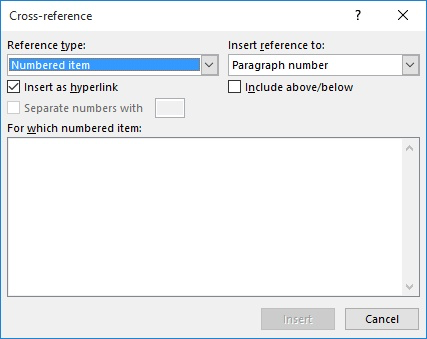
Figure 1. The Cross-reference dialog box.
You've now created a footnote within a footnote, and the numbering will always be correct. The only thing you need to ensure is that you don't print hidden text with your document. If you do, then your marker for footnote 3 will actually look like 34 (because the hidden marker for footnote 4 is right next to it). You'll also want to make sure that you update fields within your document just before printing.
WordTips is your source for cost-effective Microsoft Word training. (Microsoft Word is the most popular word processing software in the world.) This tip (8026) applies to Microsoft Word 2007, 2010, 2013, 2016, 2019, 2021, 2024, and Word in Microsoft 365. You can find a version of this tip for the older menu interface of Word here: Footnotes within Footnotes.
Learning Made Easy! Quickly teach yourself how to format, publish, and share your content using Word 2021 or Microsoft 365. With Step by Step, you set the pace, building and practicing the skills you need, just when you need them! Check out Microsoft Word Step by Step today!
When you add a footnote to a document, Word's normal formatting adds a space after the footnote number and before the ...
Discover MoreDepending on whom you are writing for, you may want your footnote and endnote references to appear a specific way. Word ...
Discover MoreDo you want to have multiple footnote references to the same actual footnote in a document? The easiest way to do this is ...
Discover MoreFREE SERVICE: Get tips like this every week in WordTips, a free productivity newsletter. Enter your address and click "Subscribe."
2026-03-02 09:41:04
Andrew
This is a terrific tip.
I'd also suggest encapsulating the hidden footnote in brackets (also formatted as hidden) so that if hidden text is printed or even if you are editing with hidden text shown it won't be so confusing if it shows up as something like "3[4]."
Andy.
Got a version of Word that uses the ribbon interface (Word 2007 or later)? This site is for you! If you use an earlier version of Word, visit our WordTips site focusing on the menu interface.
Visit the WordTips channel on YouTube

FREE SERVICE: Get tips like this every week in WordTips, a free productivity newsletter. Enter your address and click "Subscribe."
Copyright © 2026 Sharon Parq Associates, Inc.
 Please Note:
This article is written for users of the following Microsoft Word versions: 2007, 2010, 2013, 2016, 2019, 2021, 2024, and Word in Microsoft 365. If you are using an earlier version (Word 2003 or earlier), this tip may not work for you. For a version of this tip written specifically for earlier versions of Word, click here:
Please Note:
This article is written for users of the following Microsoft Word versions: 2007, 2010, 2013, 2016, 2019, 2021, 2024, and Word in Microsoft 365. If you are using an earlier version (Word 2003 or earlier), this tip may not work for you. For a version of this tip written specifically for earlier versions of Word, click here: 
Comments