

Written by Allen Wyatt (last updated November 21, 2025)
This tip applies to Word 2007, 2010, 2013, 2016, 2019, and 2021
As you are working with large or complex documents, it is often easy to lose your place and spend a lot of time trying to find information. Word includes a tool that can help you navigate through your document quickly and easily. This tool is generally referred to as the Navigation pane, though if you are still using Word 2007 you may know it as the Document Map. (Microsoft changed the name from Document Map to Navigation pane with the introduction of Word 2010.)
Displaying the Navigation pane or the Document Map is easy. Start by displaying the View tab of the ribbon. Then, in the Show group (in Word 2007 look for the Show/Hide group) make sure the Navigation Pane or Document Map check box is selected. You follow these same steps to turn this feature on and off. You can also close the Navigation pane by clicking the X in the upper-right corner of the pane. (See Figure 1.)
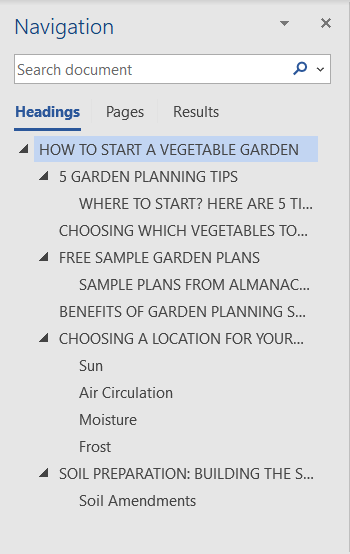
Figure 1. The Navigation Pane.
You can tell when you are using either the Navigation pane or the Document Map because an outline of your document appears at the left side of the screen, with the document text at the right.
WordTips is your source for cost-effective Microsoft Word training. (Microsoft Word is the most popular word processing software in the world.) This tip (6029) applies to Microsoft Word 2007, 2010, 2013, 2016, 2019, and 2021.

Do More in Less Time! An easy-to-understand guide to the more advanced features available in the Microsoft 365 version of Word. Enhance the quality of your documents and boost productivity in any field with this in-depth resource. Complete your Word-related tasks more efficiently as you unlock lesser-known tools and learn to quickly access the features you need. Check out Microsoft 365 Word For Professionals For Dummies today!
Word provides a hyphenation tool that can help you hyphenate words within a document. If you want to apply hyphenation to ...
Discover MoreDo you need to know the frequency with which certain words occur in your documents? There is no built-in way to derive ...
Discover MoreIf you need to move master documents or subdocuments from one place to another on your computer, you have to keep in mind ...
Discover MoreFREE SERVICE: Get tips like this every week in WordTips, a free productivity newsletter. Enter your address and click "Subscribe."
2025-11-22 09:16:44
David in Mississippi
It seems you have totally ignored the keyboard shortcut to display this feature: CTRL-F. For me, this is a much easier way to get to this pane.
Sadly, I have been unable to make the (equivalent) CMD-F shortcut work on a Mac for this. But I haven't tried building my own shortcut for this - maybe I should. But good grief, Microsoft! Why not give us this shortcut intrinsically, like you do with the PC version!?
2025-11-21 07:03:27
Malcolm Patterson
Word's Navigation pane is more than just a presentation of the document's outline that can facilitate moving around in the document. It also allows the user to rearrange the headings (and associated text) in a manner similar to working in the Outline view: A heading in the Navigation pane can be dragged up or down to re-order the sequence of headings. The associated text (including subordinate headings) will move with it.
Got a version of Word that uses the ribbon interface (Word 2007 or later)? This site is for you! If you use an earlier version of Word, visit our WordTips site focusing on the menu interface.
Visit the WordTips channel on YouTube

FREE SERVICE: Get tips like this every week in WordTips, a free productivity newsletter. Enter your address and click "Subscribe."
Copyright © 2026 Sharon Parq Associates, Inc.
Comments