
Please Note: This article is written for users of the following Microsoft Word versions: 2007, 2010, 2013, 2016, 2019, 2021, 2024, and Word in Microsoft 365. If you are using an earlier version (Word 2003 or earlier), this tip may not work for you. For a version of this tip written specifically for earlier versions of Word, click here: Displaying Quick Document Statistics.
Word tracks all sorts of information about your documents. If you know where to look, you can quickly display much of that information. For instance, if you want to quickly determine the number characters, words, lines, paragraphs, and pages in your document, you can display the Review tab of the ribbon and click the Word Count tool in the Proofing group. Word displays the Word Count dialog box, and quickly calculates the statistics about the document. (If you are working on a huge or complex document, the calculations may take a short amount of time.) (See Figure 1.)
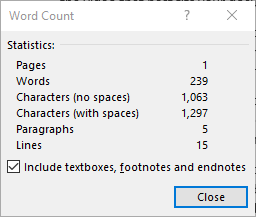
Figure 1. The Word Count dialog box.
Notice at the bottom of the dialog box is a check box that indicates whether Word should include information in the footnotes and endnotes in its calculations. You should select this option, as desired. When you are done viewing the statistics, click on the Close button.
WordTips is your source for cost-effective Microsoft Word training. (Microsoft Word is the most popular word processing software in the world.) This tip (12379) applies to Microsoft Word 2007, 2010, 2013, 2016, 2019, 2021, 2024, and Word in Microsoft 365. You can find a version of this tip for the older menu interface of Word here: Displaying Quick Document Statistics.
Discover the Power of Microsoft Office This beginner-friendly guide reveals the expert tips and strategies you need to skyrocket your productivity and use Office 365 like a pro. Mastering software like Word, Excel, and PowerPoint is essential to be more efficient and advance your career. Simple lessons guide you through every step, providing the knowledge you need to get started. Check out Microsoft Office 365 For Beginners today!
Need to grab a list of unique words appearing in a document? You can tap the power of VBA's Words collection to perform ...
Discover MoreFrames are an object you can place in your document. They go back to the earliest days of Word, before text boxes were ...
Discover MoreDo you need to compare two versions of a document to each other? Word provides a tool that can make this easy, as ...
Discover MoreFREE SERVICE: Get tips like this every week in WordTips, a free productivity newsletter. Enter your address and click "Subscribe."
2026-04-09 05:53:38
barry
@Timothy J. McGowan:
Wonderful, thank you. So elegant when you know what to do. :)
2026-04-08 18:17:26
Timothy J. McGowan
@barry:
What you point out about the ability of Word to know when we mean a mark of punctuation to end a sentence is valid. You can get by with a simpler and faster macro, though:
Sub CountItems()
' Display the number of sentences in the active document
MsgBox "Word recognizes " & ActiveDocument.Sentences.Count & " sentences in this document."
End Sub
2026-04-06 12:38:38
barry
Using Word (Office) 2021 Windows 11.
The statistics available do not include a sentence count. Is ther more to it than I have assumed?
I would like to get a count for the number of 'sentences' in a document. I am wondering what MS Word thinks of as a sentence. With a few different checks I got quite different results! After some tedious counting and testing I think a 'sentence' is any of the following...
Any apha numeric character, brackets etc followed by the paragraph mark (pilcrow).
an object (figure)
A caption will count as two sentences if full stop is included after the figure number as per:
Figure 1. caption text
Text with two pilcrows (an empty paragraph) counts as one sentence.
The punctuation marks- ! ? ... : will count as terminating a sentence; even when in tandem as in:
by saving the document!?....
Have I missed any?
Incidentally, where I have VBA code mid sentence as in: "The .Count property for the Words collection." will count as a single sentence (ignoring the mid sentence full stop). This also applies if the space after the full stop ending a sentence is missing.
As a sentence counting procedure, I came up with the following by 'cobbling' together parts from your past Tips:
Sub CountSentence() 'moves thro successive sentences
Dim intCount As Integer
Dim intSentCount As Object
'first-off, move to start of document
Selection.HomeKey Unit:=wdStory, Extend:=wdMove
For Each intSentCount In ActiveDocument.Sentences
Selection.Sentences(1).Next(Unit:=wdSentence, Count:=1).MoveEnd
intCount = intCount + 1
Next
MsgBox "Document has " & intCount & " sentences"
End Sub 'endCountSentence
This seems to give a faily accurate count based on the above 'sentence' deffinitions.
Got a version of Word that uses the ribbon interface (Word 2007 or later)? This site is for you! If you use an earlier version of Word, visit our WordTips site focusing on the menu interface.
Visit the WordTips channel on YouTube

FREE SERVICE: Get tips like this every week in WordTips, a free productivity newsletter. Enter your address and click "Subscribe."
Copyright © 2026 Sharon Parq Associates, Inc.
 Please Note:
This article is written for users of the following Microsoft Word versions: 2007, 2010, 2013, 2016, 2019, 2021, 2024, and Word in Microsoft 365. If you are using an earlier version (Word 2003 or earlier), this tip may not work for you. For a version of this tip written specifically for earlier versions of Word, click here:
Please Note:
This article is written for users of the following Microsoft Word versions: 2007, 2010, 2013, 2016, 2019, 2021, 2024, and Word in Microsoft 365. If you are using an earlier version (Word 2003 or earlier), this tip may not work for you. For a version of this tip written specifically for earlier versions of Word, click here: 
Comments